Politics
No item found!
No item found!
US President Donald Trump has warned that Britain’s efforts to deepen economic ties with China are “very dangerous,” as Prime Minister Keir Starmer defended his government’s decision to reset relations with Beijing during a high-profile visit to the country.
Trump made the remarks in Washington while responding to questions from reporters about Starmer’s China trip, speaking ahead of the premiere of the Melania film at the Kennedy Center. He did not elaborate on his comments.
“Well, it’s very dangerous for them to do that,” Trump said, referring to Britain’s growing engagement with China.
Starmer is the latest Western leader to travel to Beijing at a time when allies are grappling with Trump’s unpredictable foreign policy posture. His visit comes amid renewed US threats of trade tariffs and broader geopolitical tensions.
During three-hour talks with Chinese President Xi Jinping on Thursday, Starmer called for a “more sophisticated relationship” between the two countries, pushing for improved market access, lower tariffs and new investment agreements. The British prime minister said discussions ranged from trade to culture, including football and Shakespeare.
Around the time Trump issued his warning, Starmer addressed the UK–China Business Forum in Beijing, describing his meetings with Xi as “very warm” and saying they had delivered “real progress.”
He pointed to agreements on visa-free travel and reduced tariffs on British whisky as “really important access, symbolic of what we’re doing with the relationship.”
“That is the way that we build the mutual trust and respect that is so important,” Starmer said.
Before travelling on to Shanghai, Starmer met senior Chinese business leaders, including Yin Tongyue, chief executive of carmaker Chery. During the visit, a local official said Chery plans to open a research and development centre for its commercial vehicle division in Liverpool.
Starmer’s Labour government, which has struggled to deliver the economic growth it promised, has made strengthening ties with the world’s second-largest economy a key priority.
The visit also comes as Trump prepares for his own trip to China in April. Last week, the US president threatened to impose tariffs on Canada after Prime Minister Mark Carney struck economic agreements with Beijing during a recent visit.
Trump’s administration has also taken a hard line publicly. The Republican-led US House Foreign Affairs Committee warned on social media that “China sells nothing but cheap products and cheap friendships.”
US Commerce Secretary Howard Lutnick echoed that scepticism, questioning whether Britain would benefit from closer trade ties with Beijing.
“The Chinese are the greatest exporters and they are very, very difficult when you’re trying to export to them,” Lutnick said. “So good luck if the British are trying to export to China … it’s just unlikely.”
Asked whether Britain could face US tariffs similar to Canada’s, Lutnick said such action was unlikely unless London openly challenged Washington.
“Unless the prime minister of Britain sort of takes on the United States and says very difficult things, I doubt it,” he said.
Despite the criticism, Starmer insisted Britain could maintain strong ties with both Washington and Beijing. Speaking to reporters aboard his flight to China, he said the UK’s relationship with the United States remained one of its closest.
“The relationship we have with the United States is one of the closest … we hold,” Starmer said, citing defence, security, intelligence and trade cooperation.
He added that Britain would not be forced to choose between the two powers, noting Trump’s visit to the UK in September, which unveiled £150 billion in US investment.
A British government official said Washington was given advance notice of the objectives of Starmer’s China visit, speaking on condition of anonymity due to the sensitivity of the matter. Neither Downing Street nor China’s foreign ministry immediately responded to requests for comment.
In recent weeks, Starmer—who usually avoids direct criticism of Trump—has adopted a firmer tone. He urged the US president to apologise for what he described as “frankly appalling” remarks suggesting some NATO troops avoided frontline combat and said he would not bow to demands to annex Greenland.
Other European leaders are also increasing engagement with Beijing. German Chancellor Friedrich Merz is expected to visit China soon, following trips by Carney and French President Emmanuel Macron, who accompanied Xi on a rare visit outside Beijing in December.
As global trade tensions mount, Britain’s balancing act between its closest ally and a critical economic partner is set to face growing scrutiny.
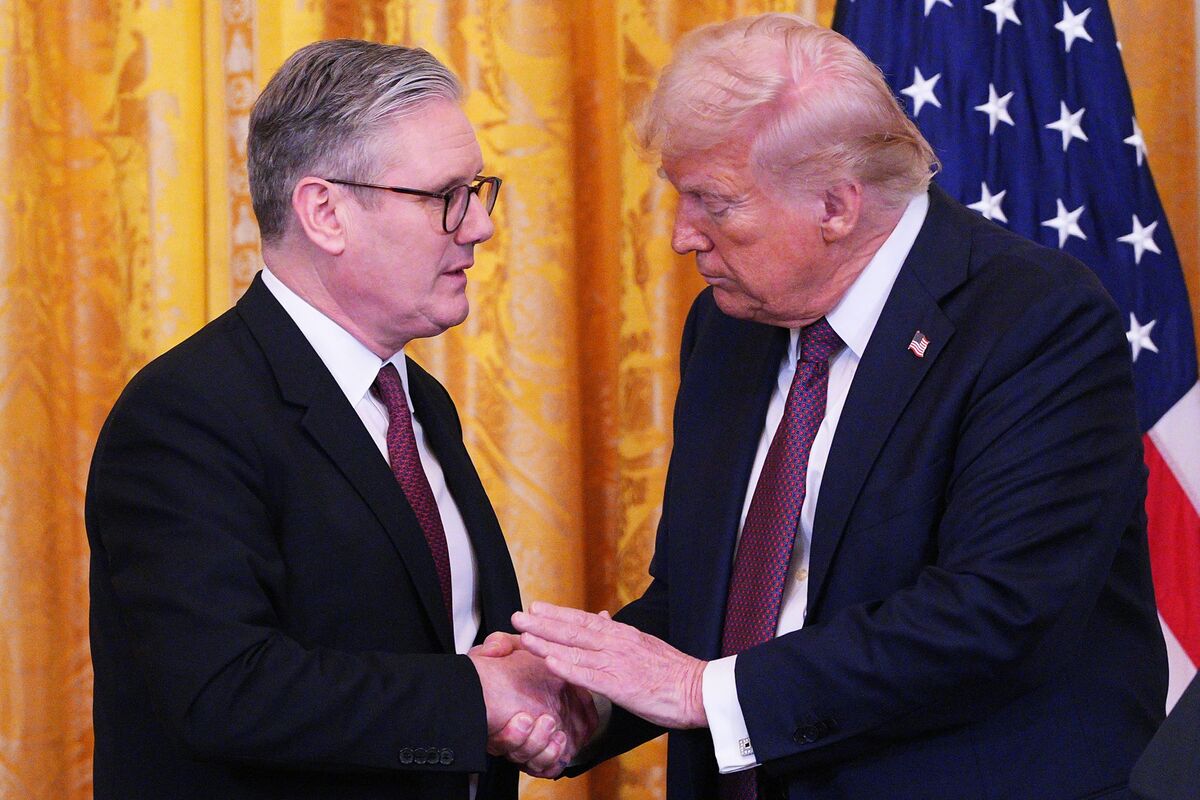
The Governor of Lagos State, Mr. Babajide Sanwo-Olu, has expressed confidence that President Bola Tinubu would be re-elected by Nigerians in the 2027 elections.
Governor Sanwo-Olu said he has no doubt Nigerians will reward President Tinubu with re-election in 2027, given the positive outcomes of his reforms, which have impacted governance and infrastructural development across the country.
Speaking during an interview session on Television Continental's Journalist Hangout on Monday, Governor Sanwo-Olu said Nigerians will re-elect President Tinubu because he has carried out many reforms and done many of the things he promised to do for Nigerians.
He said: "President Bola Tinubu has a good chance to be re-elected in 2027 because the reforms in President Tinubu's Renewed Hope Agenda have impacted governance and infrastructural development across the country.
"In this administration, revenues have accrued more to the national and subnational Governments. Prices of food have come down. We cannot deny that. We have seen better e-commerce. We have seen better foreign direct inflow into the country. We have seen a lot of people wanting to do a lot more. All our diasporal population are coming in.
"There will still be challenges, but he (President Tinubu) is smart, doing more than his very best. I absolutely believe that we should support him.
"Politically, more governors are supporting him. We had about 20 APC after the 2023 elections, and today we have 28 or 29 governors. It is a measure of success. President Tinubu is a man that’s committed to Nigeria's conversation. He will do well, and we will give him all the support.
"I am confident Nigerians will reelect President Tinubu because they can see that this President has done more work for us. He has done many of the things he promised to do. Nigerians would vote for him."
Speaking further on why he believes strongly that Nigerians will re-elect Tinubu, Governor Sanwo-Olu said, "Revenues accrued to states and local governments have had significant improvement under the administration of President Bola Tinubu.
"The price of food has reduced. There have been significant improvements in the social economic lines of our country. The Tinubu administration has done extremely well, and revenue happens to be one of them. They have been able to block loopholes and ensured compliance is in order. They have been able to monitor and ensure that proper revenues are accounted for. It has helped us to be able to do a lot more in the area of infrastructural development that we see."
Governor Sanwo-Olu also spoke about the giant strides of his administration in Lagos State through the THEMES+ Agenda in critical areas like transportation, security, entertainment, tourism, environment and technology, among others.
In what looks like a simmering hostility,towards Nigeria,the US President Donald Trump has ordered the Department of War to prepare for possible military action in the country, as he accused nigeria, of violence against Christians.
In a social media post, Trump said the United States would immediately stop all aid and assistance to Nigeria if the country fails to act against the killings of Christians. The announcement comes after the US designated Nigeria as a “Country of Particular Concern” under the International Religious Freedom Act.
The US “may very well go into that now disgraced country, ‘guns-a-blazing,’ to completely wipe out the Islamic Terrorists who are committing these horrible atrocities”, Trump added, without specifying which groups or alleged “atrocities” he was referring to.
“I am hereby instructing our Department of War to prepare for possible action. If we attack, it will be fast, vicious, and sweet, just like the terrorist thugs attack our CHERISHED Christians! WARNING: THE NIGERIAN GOVERNMENT BETTER MOVE FAST!” he wrote.
The social media post comes a day after the US president announced that Nigeria – a country almost evenly divided between a Muslim-majority north and a largely Christian south – would be added to the Department of State’s list of “Countries of Particular Concern”, which is set up to monitor religious persecution around the world.
In recent months, right-wing lawmakers and other prominent figures in the US have claimed that violent disputes in Nigeria are part of a campaign of “Christian genocide”.
Meanwhile, Nigeria’s President Bola Ahmed Tinubu has said Nigeria remains committed to upholding religious freedom and tolerance, which he described as core values of the nation’s identity.
“Nigeria stands firmly as a democracy governed by constitutional guarantees of religious liberty,” the president wrote in a reaction he personally signed on Saturday and posted on his X handle, @officialABAT.
He noted: “Since 2023, our administration has maintained an open and active engagement with Christian and Muslim leaders alike and continues to address security challenges which affect citizens across faiths and regions.
“The characterisation of Nigeria as religiously intolerant does not reflect our national reality, nor does it take into consideration the consistent and sincere efforts of the government to safeguard freedom of religion and beliefs for all Nigerians.
While human rights groups have urged the Nigerian government to do more to address unrest in the country, which has experienced deadly attacks by Boko Haram and other armed groups, experts say that claims of a “Christian genocide” are false and simplistic.
“All the data reveals is that there is no Christian genocide going on in Nigeria,” Bulama Bukarti, a Nigerian humanitarian lawyer and analyst on conflict and development, told Al Jazeera. This is “a dangerous, far-right narrative that has been simmering for a long time that President Trump is amplifying today,” he said.

The Nigeria's embattled opposition party,may now the getting its ass together,as the National Executive Committee of the party,has finally fixed the party elective national convention to elect new national officers for Nov. 15 and Nov. 16 in Ibadan,Oyo State.
The NEC disclosed this in a communique issued after its 101st meeting on Thursday in Abuja.
The party’s National Publicity Secretary, Debo Ologunagba, who read the communique, said that the PDP national chairman and national secretary had been directed to formally notify the Independent National Electoral Commission (INEC) of the national convention.
“Accordingly, NEC approved the membership composition of the National Convention Committee as well as the membership composition of the National Convention Zoning Committee to ensure a successful, transparent, and credible elective national convention,” he said.
Ologunagba further stated that NEC also directed the National Working Committee (NWC) to take immediate legal action to recover the seats of all serving members of the National and State Assemblies elected on the party’s platform but who had defected to another political party.
“By virtue of the self-executory provisions of Sections 68(1)(g) and 109(1)(g) of the Constitution of the Federal Republic of Nigeria, 1999 (as amended), such defectors have irredeemably lost their seats, there being no division or merger with regard to the PDP.
“The NEC expresses serious concern and frowns at the reported participation and involvement of some party members in the activities, meetings, and gatherings of another political party.
“The NEC calls on these members to reconsider their actions and show loyalty and commitment as members of the PDP, especially as the law does not permit membership of two political parties at the same time.
“The NEC reassures such members of the successes recorded so far towards addressing their concerns on issues relating to our party,” he said.
Ologunagba added that the NEC reassured party members and Nigerians that PDP remained a strong, united, and focused political party, repositioned to effectively play its leading opposition role in galvanising all efforts toward rescuing power from the All Progressives Congress (APC) in 2027.
He also disclosed that the NEC’s 102nd meeting had been fixed for Aug. 25. (NAN)


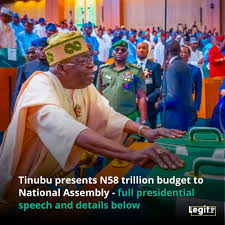
President Bola Ahmed Tinubu has presented a N58 trillion 2026 budget to the joint sitting of the National Assembly on Friday.
Tinubu, while addressing the joint session of the National Assembly, which also had the attendance of the Vice President Kashim Shettima, cabinet members, governors and other notable politicians, said the 2026 Budget was prepared against an improving global outlook.
Tinubu said the budget, titled “Budget of Consolidation, Renewed Resilience and Shared Prosperity,” is aimed at consolidating recent economic reforms and translating improved macroeconomic indicators into better living standards for Nigerians.
He also announced the end of the long-standing practice of running multiple budgets, stressing that overlapping budgets, abandoned projects and repeated rollovers had undermined effective governance.
Below is the full speech:
PROTOCOLS
Distinguished Senate President,
Rt. Honourable Speaker and Honourable Members of the House of Representatives,
Distinguished Senators and Honourable Members of the National Assembly,
Fellow Nigerians,
1. I appear before this Joint Session of the National Assembly, in fulfilment of my constitutional duty, to present the 2026 Appropriation Bill of the Federal Republic of Nigeria.
2. This is a defining moment in our national journey of reform and transformation. Over the last two and a half years, we made a deliberate choice: to confront long‑standing structural weaknesses, stabilise our economy, rebuild confidence, and lay a durable foundation for a more resilient, inclusive, and dynamic Nigeria.
3. These reforms were necessary — and they have not been painless. Families and businesses have faced pressure; established systems have been disrupted; and budget execution has been tested. I acknowledge these difficulties plainly, and I assure Nigerians that their sacrifices are not in vain. The path of reform is seldom smooth, but it is the surest route to lasting stability and shared prosperity.
4. Today, we come with a Budget that consolidates our gains, strengthens our resilience, and turns recovery into improved living standards for every Nigerian household.
THEME OF THE 2026 BUDGET
5. The 2026 Budget is themed: “Budget of Consolidation, Renewed Resilience and Shared Prosperity”. It reflects our determination to lock in macroeconomic stability, deepen competitiveness, and ensure that growth translates into decent jobs, rising incomes, and a better quality of life across our Federation.
ECONOMIC REALITIES: SIGNS OF STABILISATION, PURPOSE OF THE NEXT STEP
6. Mr. Chairman of this Joint Sitting, the 2026 Budget was prepared against an improving global outlook. Yet, our focus remains Nigeria: building a strong economy that works for our people.
7. I am encouraged that our reform efforts are already yielding measurable results:
Our economy grew by 3.98% in Q3 2025, higher than the 3.86% recorded in Q3 2024.
Inflation has moderated for eight consecutive months, with headline inflation declining to 14.45% in November 2025, from 24.23% in March 2025. With stabilising food and energy prices, tighter monetary conditions, and improving supply responses, we expect the disinflationary trend to persist—so that inflation continues to decline further over the 2026 horizon, barring major supply shocks.
Oil production has improved, supported by enhanced security, technology deployment, and sector reforms.
Non‑oil revenues have expanded significantly through better tax administration —not excessive taxation.
Investor confidence is returning, reflected in capital inflows, renewed project financing, and stronger private‑sector participation.
Our external reserves rose to a 7‑year high of about US$47 billion as at 14 November 2025, providing more than 10 months of import cover and a stronger buffer against shocks.
8. These outcomes are not accidental. They reflect difficult but deliberate policy choices. Our task now is to consolidate these gains—so that stability becomes prosperity, and prosperity becomes shared prosperity.
2025 BUDGET PERFORMANCE: LESSONS, ACCOUNTABILITY, AND EXECUTION
9. Distinguished Members, our 2025 budget implementation faced the realities of transition and competing execution demands. As at Q3 2025, we recorded:
₦18.6 trillion in revenue—representing 61% of our target; and
₦24.66 trillion in expenditure—representing 60% of our target.
10. Following the extension of the 2024 capital budget execution to December 2025, a total of ₦2.23 trillion was released for the implementation of 2024 capital projects as at June 2025.
11. While fiscal challenges persisted, government met its key obligations. However, only ₦3.10 trillion—about 17.7% of the 2025 capital budget—was released as at Q3, reflecting the emphasis on completing priority 2024 capital projects during the transition period.
12. Let me be clear: 2026 will be a year of stronger discipline in budget execution. I have issued directives to the Honourable Minister of Finance and Coordinating Minister of the Economy, the Honourable Minister of Budget and Economic Planning, the Accountant‑General of the Federation, and the Director‑General of the Budget Office of the Federation to ensure that the 2026 Budget is implemented strictly in line with the appropriated details and timelines.
13. We expect improved revenue performance through the new National Tax Acts and the ongoing reforms in the oil and gas sector—reforms designed not merely to raise revenue, but to drive transparency, efficiency, fairness, and long‑term value in our fiscal architecture.
14. I will also be unequivocal about Government‑Owned Enterprises. Heads of all GOEs are hereby directed to meet their assigned revenue targets. To support this, we will deploy end‑to‑end digitisation of revenue mobilisation—standardised e‑collections, interoperable payment rails, automated reconciliation, data‑driven risk profiling, and real‑time performance dashboards—so leakages are sealed, compliance is verifiable, and remittances are prompt. These targets will form core components of performance evaluations and institutional scorecards. Nigeria can no longer afford leakages, inefficiencies, or underperformance in strategic agencies. Every institution must play its part.
PHILOSOPHY AND OBJECTIVES OF THE 2026 BUDGET
15. Mr. Chairman and fellow Nigerians, the 2026 Budget is guided by four clear objectives:
One, consolidate macroeconomic stability;
Two, improve the business and investment environment;
Three, promote job‑rich growth and reduce poverty; and
Four, strengthen human capital while protecting the vulnerable.
16. In short: we will spend with purpose, manage debt with discipline, and pursue growth that is broad‑based — not narrow — and sustainable — not temporary.
2026 BUDGET OVERVIEW: THE FISCAL FRAMEWORK
17. Distinguished Members, the 2026 Federal Budget is anchored on realism, prudence, and growth orientation.
18. The key aggregates are as follows:
Expected total revenue: ₦34.33 trillion.
Projected total expenditure: ₦58.18 trillion, including ₦15.52 trillion for debt servicing.
Recurrent (non‑debt) expenditure: ₦15.25 trillion.
Capital expenditure: ₦26.08 trillion.
Budget deficit: ₦23.85 trillion, representing 4.28% of GDP.
19. These numbers are not just accounting lines. They are a statement of national priorities. We remain firmly committed to fiscal sustainability, debt transparency, and value‑for‑money spending.
20. The 2026–2028 Medium‑Term Expenditure Framework and Fiscal Strategy Paper sets the parameters for this Budget. Our projections are based on:
a conservative crude oil benchmark of US$64.85 per barrel;
crude oil production of 1.84 million barrels per day; and
an exchange rate of ₦1,400 to the US Dollar for the 2026 fiscal year.
21. We will continue to reduce waste, strengthen controls, and ensure that every naira borrowed or spent delivers measurable public value — especially in infrastructure, human capital, and security.
PRIORITIES AND ALLOCATIONS: SECURITY, PEOPLE, PRODUCTIVITY
22. Our allocations reflect the Renewed Hope Agenda and the practical needs of Nigerians. Key sectoral provisions include:
Defence and Security: ₦5.41 trillion
Infrastructure: ₦3.56 trillion
Education: ₦3.52 trillion
Health: ₦2.48 trillion
23. These priorities are interlinked. Without security, investment will not thrive. Without educated and healthy citizens, productivity will not rise. Without infrastructure, jobs and enterprise will not scale. This is why the Budget is designed as one coherent programme of national renewal.
A. National Security and Peacebuilding
24. Security remains the foundation of development. The 2026 Budget strengthens support for:
modernisation of the Armed Forces;
intelligence‑driven policing and joint operations;
border security and technology‑enabled surveillance; and
community‑based peacebuilding and conflict prevention.
25. We will invest in security with clear accountability for outcomes—because security spending must deliver security results. To secure our country, our priority will remain on increasing the fighting capability of our armed forces and other security agencies by boosting personnel and procuring cutting-edge platforms and other hardware. We are also pursuing a new era of criminal justice system to stamp out terrorism, banditry, kidnapping for ransom and other violent crimes. Our administration is resetting the national security architecture and establishing a new national counterterrorism doctrine—a holistic redesign anchored on unified command, intelligence, community stability, and counter-insurgency. This new doctrine will fundamentally change how we confront terrorism and other violent crimes that have become existential threats to our corporate survival and have heightened anxiety among our people.
Henceforth, and under this new architecture, any armed group or gun-wielding non-state actors operating outside state authority will be regarded as terrorists. These include bandits, militias, armed gangs, criminal networks with weapons, armed robbers, violent cult groups, forest-based armed collectives, and foreign-linked mercenaries. Groups or individuals conducting violence for political, ethnic, financial, or sectarian objectives are also classified as terrorists. Members of any group extorting communities, kidnapping civilians, occupying or seeking to occupy territory within Nigeria will be classified as terrorists. The denominator is that if you wield lethal weapons and act outside the state’s authority, you are a terrorist. Any individual or entity that enables the listed groups as financiers, money handlers, harbourers, informants, ransom facilitators, and negotiators will also be classified as terrorists. Political protectors and intermediaries, transporters, arms suppliers, and safe-house owners will be declared as terrorists. Politicians, traditional rulers, community leaders, and religious leaders who facilitate and encourage violent actions and terror within Nigeria and against our citizens are also terrorists.
B. Human Capital Development: Education and Health
26. No nation can grow beyond the quality of its people. The 2026 Budget strengthens investments in education, skills, healthcare, and social protection.
27. In education, we are expanding access to higher education through the Nigerian Education Loan Fund. Over 418,000 students have been supported, in partnership with 229 tertiary institutions nationwide.
28. In healthcare, I am pleased to highlight that investment in healthcare is 6% of total budget size, net of liabilities.
29. We also appreciate the support of international partners. Recent high‑level engagements with the Government of the United States have opened the door to over US$500 million in grant funding for targeted health interventions across Nigeria. We welcome this partnership and assure Nigerians that these resources will be deployed transparently and effectively.
C. Infrastructure and Economic Productivity
30. Across the nation, projects under the Renewed Hope Agenda are moving from vision to reality—transport and energy infrastructure, port modernisation, agricultural reforms, and strategic investments that unlock private capital.
31. We will take decisive steps to strengthen agricultural markets. Food security is national security. The 2026 Budget prioritises input financing and mechanisation; irrigation and climate‑resilient agriculture; storage and processing; and agro‑value chains.
32. These measures will reduce post‑harvest losses, improve incomes for smallholders, deepen agro‑industrialisation, and build a more resilient, diversified economy.
DELIVERY, DISCIPLINE, AND NATIONAL COMPACT
33. Distinguished Members and fellow Nigerians, the greatest budget is not the one we announce. It is the one we deliver.
34. Therefore, 2026 will be guided by three practical commitments:
Better revenue mobilisation through efficiency, transparency, and compliance—especially from GOEs and improved oil and gas sector governance.
Better spending: prioritising projects that can be completed, measured, and felt by citizens.
Better accountability: strengthening procurement discipline, monitoring, and reporting—so Nigerians can see what their money is funding.
35. This is how we will build trust: by matching our words with results, and our allocations with outcomes.
CONCLUSION: A BUDGET THAT BELONGS TO ALL OF US
36. Distinguished Members of the National Assembly, fellow Nigerians, the 2026 Budget is not a budget of promises; it is a Budget of Consolidation, Renewed Resilience and Shared Prosperity. It builds on the reforms of the past two and a half years, addresses emerging challenges, and sets a clear path towards a more secure, more competitive, more equitable, and more hopeful Nigeria.
37. I commend the understanding, sacrifice, and resilience of our people. My administration remains committed to easing the burdens of transition and ensuring that the benefits of reform reach households and communities across the Federation.
38. With unity of purpose between the Executive and the Legislature—and with the resilience of the Nigerian people—we will deliver the full promise of the Renewed Hope Agenda.
39. It is with great pleasure, therefore, that I lay before this distinguished Joint Session of the National Assembly the 2026 Appropriation Bill of the Federal Republic of Nigeria, titled: “Budget of Consolidation, Renewed Resilience and Shared Prosperity”.
May God bless the Federal Republic of Nigeria.
Thank you.
President Bola Ahmed Tinubu has presented a N58 trillion 2026 budget to the joint sitting of the National Assembly on Friday.
Tinubu, while addressing the joint session of the National Assembly, which also had the attendance of the Vice President Kashim Shettima, cabinet members, governors and other notable politicians, said the 2026 Budget was prepared against an improving global outlook.
Tinubu said the budget, titled “Budget of Consolidation, Renewed Resilience and Shared Prosperity,” is aimed at consolidating recent economic reforms and translating improved macroeconomic indicators into better living standards for Nigerians.
He also announced the end of the long-standing practice of running multiple budgets, stressing that overlapping budgets, abandoned projects and repeated rollovers had undermined effective governance.
Below is the full speech:
PROTOCOLS
Distinguished Senate President,
Rt. Honourable Speaker and Honourable Members of the House of Representatives,
Distinguished Senators and Honourable Members of the National Assembly,
Fellow Nigerians,
1. I appear before this Joint Session of the National Assembly, in fulfilment of my constitutional duty, to present the 2026 Appropriation Bill of the Federal Republic of Nigeria.
2. This is a defining moment in our national journey of reform and transformation. Over the last two and a half years, we made a deliberate choice: to confront long‑standing structural weaknesses, stabilise our economy, rebuild confidence, and lay a durable foundation for a more resilient, inclusive, and dynamic Nigeria.
3. These reforms were necessary — and they have not been painless. Families and businesses have faced pressure; established systems have been disrupted; and budget execution has been tested. I acknowledge these difficulties plainly, and I assure Nigerians that their sacrifices are not in vain. The path of reform is seldom smooth, but it is the surest route to lasting stability and shared prosperity.
4. Today, we come with a Budget that consolidates our gains, strengthens our resilience, and turns recovery into improved living standards for every Nigerian household.
THEME OF THE 2026 BUDGET
5. The 2026 Budget is themed: “Budget of Consolidation, Renewed Resilience and Shared Prosperity”. It reflects our determination to lock in macroeconomic stability, deepen competitiveness, and ensure that growth translates into decent jobs, rising incomes, and a better quality of life across our Federation.
ECONOMIC REALITIES: SIGNS OF STABILISATION, PURPOSE OF THE NEXT STEP
6. Mr. Chairman of this Joint Sitting, the 2026 Budget was prepared against an improving global outlook. Yet, our focus remains Nigeria: building a strong economy that works for our people.
7. I am encouraged that our reform efforts are already yielding measurable results:
Our economy grew by 3.98% in Q3 2025, higher than the 3.86% recorded in Q3 2024.
Inflation has moderated for eight consecutive months, with headline inflation declining to 14.45% in November 2025, from 24.23% in March 2025. With stabilising food and energy prices, tighter monetary conditions, and improving supply responses, we expect the disinflationary trend to persist—so that inflation continues to decline further over the 2026 horizon, barring major supply shocks.
Oil production has improved, supported by enhanced security, technology deployment, and sector reforms.
Non‑oil revenues have expanded significantly through better tax administration —not excessive taxation.
Investor confidence is returning, reflected in capital inflows, renewed project financing, and stronger private‑sector participation.
Our external reserves rose to a 7‑year high of about US$47 billion as at 14 November 2025, providing more than 10 months of import cover and a stronger buffer against shocks.
8. These outcomes are not accidental. They reflect difficult but deliberate policy choices. Our task now is to consolidate these gains—so that stability becomes prosperity, and prosperity becomes shared prosperity.
2025 BUDGET PERFORMANCE: LESSONS, ACCOUNTABILITY, AND EXECUTION
9. Distinguished Members, our 2025 budget implementation faced the realities of transition and competing execution demands. As at Q3 2025, we recorded:
₦18.6 trillion in revenue—representing 61% of our target; and
₦24.66 trillion in expenditure—representing 60% of our target.
10. Following the extension of the 2024 capital budget execution to December 2025, a total of ₦2.23 trillion was released for the implementation of 2024 capital projects as at June 2025.
11. While fiscal challenges persisted, government met its key obligations. However, only ₦3.10 trillion—about 17.7% of the 2025 capital budget—was released as at Q3, reflecting the emphasis on completing priority 2024 capital projects during the transition period.
12. Let me be clear: 2026 will be a year of stronger discipline in budget execution. I have issued directives to the Honourable Minister of Finance and Coordinating Minister of the Economy, the Honourable Minister of Budget and Economic Planning, the Accountant‑General of the Federation, and the Director‑General of the Budget Office of the Federation to ensure that the 2026 Budget is implemented strictly in line with the appropriated details and timelines.
13. We expect improved revenue performance through the new National Tax Acts and the ongoing reforms in the oil and gas sector—reforms designed not merely to raise revenue, but to drive transparency, efficiency, fairness, and long‑term value in our fiscal architecture.
14. I will also be unequivocal about Government‑Owned Enterprises. Heads of all GOEs are hereby directed to meet their assigned revenue targets. To support this, we will deploy end‑to‑end digitisation of revenue mobilisation—standardised e‑collections, interoperable payment rails, automated reconciliation, data‑driven risk profiling, and real‑time performance dashboards—so leakages are sealed, compliance is verifiable, and remittances are prompt. These targets will form core components of performance evaluations and institutional scorecards. Nigeria can no longer afford leakages, inefficiencies, or underperformance in strategic agencies. Every institution must play its part.
PHILOSOPHY AND OBJECTIVES OF THE 2026 BUDGET
15. Mr. Chairman and fellow Nigerians, the 2026 Budget is guided by four clear objectives:
One, consolidate macroeconomic stability;
Two, improve the business and investment environment;
Three, promote job‑rich growth and reduce poverty; and
Four, strengthen human capital while protecting the vulnerable.
16. In short: we will spend with purpose, manage debt with discipline, and pursue growth that is broad‑based — not narrow — and sustainable — not temporary.
2026 BUDGET OVERVIEW: THE FISCAL FRAMEWORK
17. Distinguished Members, the 2026 Federal Budget is anchored on realism, prudence, and growth orientation.
18. The key aggregates are as follows:
Expected total revenue: ₦34.33 trillion.
Projected total expenditure: ₦58.18 trillion, including ₦15.52 trillion for debt servicing.
Recurrent (non‑debt) expenditure: ₦15.25 trillion.
Capital expenditure: ₦26.08 trillion.
Budget deficit: ₦23.85 trillion, representing 4.28% of GDP.
19. These numbers are not just accounting lines. They are a statement of national priorities. We remain firmly committed to fiscal sustainability, debt transparency, and value‑for‑money spending.
20. The 2026–2028 Medium‑Term Expenditure Framework and Fiscal Strategy Paper sets the parameters for this Budget. Our projections are based on:
a conservative crude oil benchmark of US$64.85 per barrel;
crude oil production of 1.84 million barrels per day; and
an exchange rate of ₦1,400 to the US Dollar for the 2026 fiscal year.
21. We will continue to reduce waste, strengthen controls, and ensure that every naira borrowed or spent delivers measurable public value — especially in infrastructure, human capital, and security.
PRIORITIES AND ALLOCATIONS: SECURITY, PEOPLE, PRODUCTIVITY
22. Our allocations reflect the Renewed Hope Agenda and the practical needs of Nigerians. Key sectoral provisions include:
Defence and Security: ₦5.41 trillion
Infrastructure: ₦3.56 trillion
Education: ₦3.52 trillion
Health: ₦2.48 trillion
23. These priorities are interlinked. Without security, investment will not thrive. Without educated and healthy citizens, productivity will not rise. Without infrastructure, jobs and enterprise will not scale. This is why the Budget is designed as one coherent programme of national renewal.
A. National Security and Peacebuilding
24. Security remains the foundation of development. The 2026 Budget strengthens support for:
modernisation of the Armed Forces;
intelligence‑driven policing and joint operations;
border security and technology‑enabled surveillance; and
community‑based peacebuilding and conflict prevention.
25. We will invest in security with clear accountability for outcomes—because security spending must deliver security results. To secure our country, our priority will remain on increasing the fighting capability of our armed forces and other security agencies by boosting personnel and procuring cutting-edge platforms and other hardware. We are also pursuing a new era of criminal justice system to stamp out terrorism, banditry, kidnapping for ransom and other violent crimes. Our administration is resetting the national security architecture and establishing a new national counterterrorism doctrine—a holistic redesign anchored on unified command, intelligence, community stability, and counter-insurgency. This new doctrine will fundamentally change how we confront terrorism and other violent crimes that have become existential threats to our corporate survival and have heightened anxiety among our people.
Henceforth, and under this new architecture, any armed group or gun-wielding non-state actors operating outside state authority will be regarded as terrorists. These include bandits, militias, armed gangs, criminal networks with weapons, armed robbers, violent cult groups, forest-based armed collectives, and foreign-linked mercenaries. Groups or individuals conducting violence for political, ethnic, financial, or sectarian objectives are also classified as terrorists. Members of any group extorting communities, kidnapping civilians, occupying or seeking to occupy territory within Nigeria will be classified as terrorists. The denominator is that if you wield lethal weapons and act outside the state’s authority, you are a terrorist. Any individual or entity that enables the listed groups as financiers, money handlers, harbourers, informants, ransom facilitators, and negotiators will also be classified as terrorists. Political protectors and intermediaries, transporters, arms suppliers, and safe-house owners will be declared as terrorists. Politicians, traditional rulers, community leaders, and religious leaders who facilitate and encourage violent actions and terror within Nigeria and against our citizens are also terrorists.
B. Human Capital Development: Education and Health
26. No nation can grow beyond the quality of its people. The 2026 Budget strengthens investments in education, skills, healthcare, and social protection.
27. In education, we are expanding access to higher education through the Nigerian Education Loan Fund. Over 418,000 students have been supported, in partnership with 229 tertiary institutions nationwide.
28. In healthcare, I am pleased to highlight that investment in healthcare is 6% of total budget size, net of liabilities.
29. We also appreciate the support of international partners. Recent high‑level engagements with the Government of the United States have opened the door to over US$500 million in grant funding for targeted health interventions across Nigeria. We welcome this partnership and assure Nigerians that these resources will be deployed transparently and effectively.
C. Infrastructure and Economic Productivity
30. Across the nation, projects under the Renewed Hope Agenda are moving from vision to reality—transport and energy infrastructure, port modernisation, agricultural reforms, and strategic investments that unlock private capital.
31. We will take decisive steps to strengthen agricultural markets. Food security is national security. The 2026 Budget prioritises input financing and mechanisation; irrigation and climate‑resilient agriculture; storage and processing; and agro‑value chains.
32. These measures will reduce post‑harvest losses, improve incomes for smallholders, deepen agro‑industrialisation, and build a more resilient, diversified economy.
DELIVERY, DISCIPLINE, AND NATIONAL COMPACT
33. Distinguished Members and fellow Nigerians, the greatest budget is not the one we announce. It is the one we deliver.
34. Therefore, 2026 will be guided by three practical commitments:
Better revenue mobilisation through efficiency, transparency, and compliance—especially from GOEs and improved oil and gas sector governance.
Better spending: prioritising projects that can be completed, measured, and felt by citizens.
Better accountability: strengthening procurement discipline, monitoring, and reporting—so Nigerians can see what their money is funding.
35. This is how we will build trust: by matching our words with results, and our allocations with outcomes.
CONCLUSION: A BUDGET THAT BELONGS TO ALL OF US
36. Distinguished Members of the National Assembly, fellow Nigerians, the 2026 Budget is not a budget of promises; it is a Budget of Consolidation, Renewed Resilience and Shared Prosperity. It builds on the reforms of the past two and a half years, addresses emerging challenges, and sets a clear path towards a more secure, more competitive, more equitable, and more hopeful Nigeria.
37. I commend the understanding, sacrifice, and resilience of our people. My administration remains committed to easing the burdens of transition and ensuring that the benefits of reform reach households and communities across the Federation.
38. With unity of purpose between the Executive and the Legislature—and with the resilience of the Nigerian people—we will deliver the full promise of the Renewed Hope Agenda.
39. It is with great pleasure, therefore, that I lay before this distinguished Joint Session of the National Assembly the 2026 Appropriation Bill of the Federal Republic of Nigeria, titled: “Budget of Consolidation, Renewed Resilience and Shared Prosperity”.
May God bless the Federal Republic of Nigeria.
Thank you.
The Minister of Innovation, Science, and Technology, Geoffrey Uche Nnaji, has resigned following allegations of certificate forgery levelled against him.
President Bola Tinubu’s Special Adviser on Information and Strategy, Bayo Onanuga, confirmed the resignation in a statement on Tuesday, saying the President has accepted the Minister’s decision to step down.
According to Onanuga, President Tinubu “accepted the resignation of Geoffrey Uche Nnaji, the Minister of Innovation, Science, and Technology, following some allegations against him.”
He added that “President Tinubu appointed Nnaji in August 2023. He resigned today in a letter thanking the President for allowing him to serve Nigeria.”
Onanuga further quoted the former Minister as saying he had “been a target of blackmail by political opponents.” “President Tinubu thanked him for his service and wished him well in future endeavours,” the statement added.

Mixed reactions have continued to trail Thurdday's emergence of Prof. Nentawe Yilwatda as the substantive national chairman of the ruling All Progressives Congress (APC),as there has been permutations, over the political calculations that led to his selection.
Nentawe, who currently serves in the federal cabinet as Minister of Humanitarian Affairs, Disaster Management and Social Development, became the party’s fifth substantive national chairman during the APC’s 14th National Executive Committee (NEC) meeting held at the Presidential Villa, Abuja.
However, multiple party sources have offered differing accounts of why the minister was ultimately chosen.
The APC’s National Director of Publicity, Bala Ibrahim, in a telephone interview with Daily Trust, said Nentawe’s emergence reflected a deliberate shift from the tradition of appointing former governors as party chairmen.
“What I understand is that they wanted a technocrat—something different from the previous tradition, where each time they pick a former governor as chairman. They wanted someone who could steer the party towards the convention. But the politicking itself is best known to the politicians,” he said.
Asked whether the decision was also aimed at pacifying the North Central and balancing religious sensitivities, especially amid persistent criticism of the Muslim-Muslim ticket, Ibrahim said, “It’s possible. Those factors may have played out.”
On whether the new chairman has the capacity to deliver for President Bola Ahmed Tinubu and the APC in 2027, he added, “He was the Director General of the Tinubu/Shettima Campaign in Plateau in 2023, and while the state didn’t vote APC, they did their best.”
Insiders also hinted that President Tinubu and his team are strategically targeting states that did not vote for him in 2023, with some of his recent appointments in the North seen as politically calculated moves to win support ahead of 2027.
Following Ganduje’s resignation, the party’s Deputy National Chairman (North), Ali Bukar Dalori, held the position in an acting capacity until Nentawe’s emergence.
Commenting on the development, political analyst Jackson Lekan Ojo said Nentawe was picked because Tinubu wanted a loyal party leader ahead of the 2027 general election.
“The main reason they brought him is that they were looking for somebody who can be loyal to President Tinubu. Somebody they can use. Somebody who can’t betray Mr. President,” he said.
“Al-Makura would have been good, Senator Sani Musa from Niger State would have been good – they’re all from the North Central. But these are people that are independent-minded.”
On the religious angle, Ojo added: “It was accidental. That never was in their calculation.”
He said the political permutations that produced the minister as chairman were far-reaching, possibly part of a broader plan to reclaim Plateau State in the next presidential election.
According to him, Tinubu’s political calculations are often difficult to predict, and there could be a pact with Governor Caleb Mutfwang of Plateau State to deliver the state for the APC in 2027, while the governor remains in office on the platform of the Peoples Democratic Party (PDP).
Thursday’s NEC meeting was attended by key APC stakeholders, including President Bola Ahmed Tinubu, Vice President Kashim Shettima, APC governors, state chairmen, members of the National Working Committee (NWC), and others.
Nentawe resumes, says door open to Kwankwaso, others
Shortly after his emergence, Nentawe resumed duties at the APC national secretariat in Abuja.
Addressing members of the NWC, party supporters, and other stakeholders, the new chairman pledged to work with party leaders to consolidate the APC’s electoral dominance and strengthen democracy.
He declared that the party’s doors were open to new members, including governors and lawmakers, and expressed confidence that the 2027 elections were already in the bag.
“Like I said in my acceptance speech, all of us here, especially the NWC, we are the mechanics; the party is the vehicle. We will fix it, we will drive it, we will work it and ensure that we get to the destination.
“It’s our collective effort, and I’m sure by the time we put our hands on the deck collectively, this party will be great. This party will be the joy, the pride and the light of the entire nation, and that’s what I look forward to this party becoming under our collective leadership.
“I appreciate Nigerians supporting APC, standing by APC. Our doors are open to welcome new members. We look forward to having more governors, more National Assembly members, more local government chairmen into our party. We will expand beyond bounds. By God’s grace, I’m sure the 2027 election is a done deal for APC,” he said.
In a later interview with Channels Television, Nentawe confirmed that discussions with key opposition figures, including the leader of the New Nigeria People’s Party (NNPP), Senator Rabiu Musa Kwankwaso, were ongoing. He said defections would happen naturally when the time was right.
“I told you our doors are open,” he said when asked about Kwankwaso’s rumoured return to the APC. “When everybody’s time is due, it will manifest itself. And that’s what’s going on for everybody who has come back to APC. It’s just giving time to people.”
Nentawe said many politicians were increasingly drawn to the APC due to the party’s policies and the performance of the Tinubu administration.
“People are seeing the manifesto of the party, seeing the performance of the government, seeing also the tough decisions the president has taken,” he said.
He described the APC as the strongest political platform in the country and vowed to further unite and expand the party.
“Our job is to unite the party, expand the party, and bring more governors in. If Nigerians feel strongly that APC can meet their political needs, why not? We are not saying that we want a one-party state. Never. We want to drive this party as the most preferred party in Nigeria,” he explained.
The APC chairman dismissed the recently formed opposition coalition—comprising members of the Peoples Democratic Party (PDP), Labour Party (LP), under the African Democratic Congress (ADC)—as posing no real threat to the ruling party.
“There is no opposition for now,” he said. “Zero fear at all. We will win. I can assure you. The by-elections in the last two years were all won by the APC, most of them by a landslide. We welcome their criticism because it helps us to improve our performance.”
He also highlighted what he described as key achievements of the Tinubu administration, including increased government revenue and rising oil production.
“Wait and listen,” he said. “We are improving revenue, and the government is celebrating it. Even the opposition governors are celebrating that there’s improvement. Crude oil production has risen from less than one million barrels per day to 1.5 million, and now hitting two million barrels per day. Is that not direction?”
On the security front, Nentawe said the situation had improved significantly, citing the return of over 30,000 Nigerian refugees from Chad and Cameroon.
“Places that were taken over by Boko Haram, that people could not access, are now safe,” he said. “Security has improved. We invited the UN and IOM, and they confirmed these improvements.”
He urged Nigerians to keep faith with the APC-led government, assuring them that the “renewed hope” agenda was beginning to yield results.
“My message to Nigerians is that there’s already light at the end of the tunnel, and all of us can work together to achieve greater things for this country,” he said. “The sacrifice we’re making is for the absolute benefit of all of us as a country.”
Meanwhile, following the resignation of Festus Fuanter (also from Plateau) as deputy national secretary, the party announced new appointments. National Legal Adviser Prof. Abdulkarim Kana (Nasarawa, North Central) was moved to deputy national secretary, while Murtala Kankia (Katsina, North West) became the new national legal adviser.
His emergence will boost our chances – Plateau APC
Reacting to the development, acting spokesperson of the APC in Plateau State, Shittu Bamaiyi, said Nentawe’s emergence would boost the party’s chances in the state and increase the likelihood of reclaiming Plateau from the PDP in 2027.
He said: “For President Tinubu to have opted for Prof Nentawe among other contending interests and political juggernauts from the North Central zone is not only instructive, but reflects the absolute trust and confidence the president has in the minister to effectively pilot the affairs of the APC in the face of daunting political challenges.
“Indeed, the choice of Nentawe is in recognition and appreciation of his capacity and competence. In the same vein, the choice of Prof Nentawe marks a watershed and an inspiring awakening of confidence in the people of Plateau State, which requires reciprocity from the people of the state.”
Bashir Musan Sati, a former APC secretary and stakeholder in the party, also hailed the appointment, saying it would strengthen the APC in Plateau and across the country.
Nentawe is fit for the job – Lalong
Similarly, former governor of Plateau State, Senator Simon Lalong, considered the new chairman’s political mentor, described his emergence as a source of joy and inspiration, stating that he brings fresh leadership experience and the capacity to lead the “biggest political party in Africa.”
In a statement by his media aide, Makut Simon Macham, Lalong said Nentawe is “very suitable” for the job, noting his vast experience as a technocrat, politician, and public servant.
The former governor said the new assignment was a clear endorsement of Nentawe’s influence as APC governorship candidate in 2023 and reflected the wide acceptability and visionary leadership qualities he possesses.
He’s no threat to us – Plateau PDP
Meanwhile, the Plateau State chapter of the Peoples Democratic Party (PDP) has said the emergence of Nentawe as APC national chairman poses no threat to its 2027 electoral chances.
The state organising secretary of the PDP, Yakubu ChoCho, told Daily Trust that the party remains unshakable and confident of victory.
“While I congratulate Nentawe as the new chairman of the APC, his emergence will not change the popularity of the PDP. Of course, he was nominated to pilot the affairs of the party nationally. But coming back to Plateau, where he belongs, the people of Plateau have their voice.
“The people of Plateau always elect people who align with their heritage. That is why people choose PDP—because the party is in their blood. Nentawe coming on board will never change what is happening in the state.
“The voice of Plateau speaks for PDP. You can equate Plateau with Anambra, where APGA dominates politics. So, PDP is the party to beat in Plateau.
“I am assuring you that the people of Plateau State will vote PDP from top to bottom despite the emergence of Nentawe. Plateau has already decided to continue supporting PDP,” he said.
Tinubu charges govs to deliver change, build new party secretariat
Speaking during the NEC meeting, President Tinubu emphasised the need for increased community engagement and responsiveness to citizens’ concerns.
“Nigerians are still complaining at the grassroots,” the president said. “To you, the governors, you must wet the grass more and deliver progressive change to Nigerians. May God bless our democracy and grant us more fertile lands.”
He reaffirmed his administration’s commitment to food sovereignty and urged his team to continue working towards national development.
“To those working with me to achieve food sovereignty for our country, we will continue to work hard for you, Nigerians, and to listen to everyone to achieve the national goals,” he added.
The president reiterated the APC’s inclusive posture, stating that the party remains open to new members and fresh ideas. He dismissed the opposition as “a coalition of confusion” and urged progressive-minded Nigerians to join the APC and support its developmental vision.
“Our doors are still open, and we should wholeheartedly embrace those who join us,” Tinubu said.
He urged the new national chairman to form a committee of NWC members to visit states and ensure that new members are properly registered and integrated into the party.
The president also thanked Dr Abdullahi Ganduje, the former national chairman, for his contributions to the party’s development and ideological clarity.
Tinubu further charged APC governors to work collectively to build a permanent party secretariat in Abuja, urging them to leave behind a lasting legacy.
“We should leave a legacy of development. The governors are here—23 of them—to help identify a land, along with the Minister of the Federal Capital Territory. We should establish a committee of progressive governors to identify suitable land and construct the secretariat,” he said.
While acknowledging ongoing economic challenges, Tinubu highlighted progress under his administration. He cited the N14.9 trillion in revenue collected by the Federal Inland Revenue Service (FIRS) in the first half of the year—a 43 per cent increase from the same period in 2024—as evidence of improvement.
The president and other NEC members also paid tribute to former President Muhammadu Buhari, who recently died in London and was buried in his hometown of Daura, Katsina State.

'Politics is the art of choosing between the disastrous and the unpalatable'.These words Canadian American Economist ,John Kenneth Galbraith,came to fore,when the expected news of Rivers state Governor Siminalayi Fubara,came that,he and his supporters,have left the Peoples Democratic Party (PDP), and joined the ruling All Progressives Congress (APC).
Fubara announced the move on Tuesday during a stakeholders’ meeting at the Government House in Port Harcourt.
Speaking at the meeting, the governor said, “We can’t support President (Tinubu) if we don’t fully identify with him, not just the backyard support.
“So we have taken that decision here today that everyone who has followed, who has suffered with me, our decision today, this evening is that we are moving to the APC.”
His defection followed a visit to President Bola Tinubu at the State House, Abuja, on Monday.
The Presidential Protocol Liaison Officer received Fubara at about 5:01 p.m. before proceeding to the President’s office for a closed-door meeting.
Earlier, the defection of the Speaker of the Rivers State House of Assembly, Martin Amaewhule, and 15 other PDP lawmakers to the APC signalled worsening factional tensions within the opposition party.However,it has further highlighted the cry of the opposition in Nigeria,that President Tinubu,is trying to turn the country,into one party state

It was a very big embarrassment for Nicholas Ukachukwu, the governorship candidate of the All Progressives Congress (APC) in the forthcoming Anambra governorship election, when he was accosted by aggrieved subscribers who allegedly paid him N1Billion to his estate business, Chupi Company Limited, for the issuance of land that has not been delivered for three years.
The subscribers have been looking for him where he was allegedly hiding, at the Transcop Hotel, Abuja, and they blocked his way claiming he was owing them a debt of N1Billion which he had refused to pay, in relation to the issuance of land which has not be given to them.
It took the intervention of his security men and officials of the hotel to rescue the confused politician, who was in the company of his family members from the wrath of the men. In a social media video currently in circulation, Ukachukwu was seen been protected from the some persons suspected to be involved in the incident.
In another development, the coalition of over forty Civil Society Organisations (CSOs) has allegedly received a petition from the aggrieved subscribers against Sen. Ukachukwu’s Chupi Company Limited for an alleged fraud of N1Billion relating to the landed property.
According to the Coalition, the subscribers paid the money to Zoe Dew Dawn Nigeria Ltd, a real estate firm that has shown sufficient proof of sending the same sum of money since the year 2022 to Chupi Company Limited for the estate land, as alleged.
Shockingly, three years have passed, yet not a single plot of land has not been allocated, nor has their hard-earned money been refunded.
Despite several efforts to get Sen. Ukachukwu to honour the agreement reached by the subscribers, he has continued to demonstrate tendencies that left the owners with no option but to go public for the APC governorship candidate to be compelled to pay or release the land according to sources.
The Coalition has pointed out that the situation is not only a monumental breach of trust but also a direct assault on transparency, accountability, good governance, and values which public servants and political leaders ought to embody.
The refusal or failure of Sen. Ukachukwu's Chupi Company Limited to fulfill its contractual and moral obligation to its subscribers casts a dark shadow on his integrity and raises serious questions about his fitness to lead Anambra State, according to the CSO.
On behalf of the aggrieved subscribers, the CSO coalition has issued a seven-day ultimatum to Sen. Ukachukwu and Chupi Company Limited to either refund the ₦1 billion paid by the subscribers or issue the estate lands as agreed.
The Coalition has categorically stated that failure to comply with these demands within the stipulated period will leave the subscribers with no other option than to occupy the streets of Anambra in peaceful but resolute protest until justice is served.
The coalition therefore called on relevant regulatory agencies, anti-corruption bodies, and law enforcement agencies to take immediate interest in this case and ensure that justice is delivered without fear or favour.
“We will also present a petition before the Anambra State Chapter of APC, the National Secretariat of APC, the Independent National Electoral Commission (INEC), the Commissioner of Police, Anambra State Command, the Inspector General of Police, and the Director General of the Department of State Services (DSS),” the Coalition added.

Four days, three countries: US president Donald Trump arrived in the United Arab Emirates on Thursday after having started his tour of several Gulf states on Tuesday.
The American president touched down in Abu Dhabi, where he was greeted by President Sheikh Mohammed bin Zayed Al Nahyan. Trump was then given a tour of the Sheikh Zayed Grand Mosque, which he called "beautiful".
The trip is part of a four-day visit of Qatar, Saudi Arabia and the United Arab Emirates, Trump's first major overseas tour of his second term as president.
These countries, among the world's wealthiest nations due to their oil-rich territories, have shown keen interest in closer ties with the US since Trump returned into office.
A deal emblematic of this new relationship was announced with Saudia Arabia on Tuesday: while the US pledged to sell Saudi Arabia an arms package valued at nearly $142 billion dollars, the Middle Eastern country in turn announced a $600 billion dollar commitment to invest in the United States.
Whether similarly significant deals with the United Arab Emirates are to be announced soon remains to be seen, yet the possibility exists.
Meanwhile, Qatar announced that it wanted to gift Trump a $400 million luxury plane to replace his Air Force One. Trump said that he was planning on accepting the gift, despite sparking outrage among Democrats and causing concerns for the ethical, security and legal implications of the move.
The White House did not outline how UAE investments would reach $1.4 trillion, with some of the deals unveiled as part of the framework having already been announced.

The Federal High Court in Abuja has released the Certified True Copy (CTC) of the judgement sentencing the leader of the proscribed Indigenous People of Biafra (IPOB), Nnamdi Kanu to life imprisonment.
This follows an hour-long judgement delivered by Justice James Omotoso on Thursday where the IPOB leader was convicted of all the seven counts of terrorism charges levelled against him by the Federal government of Nigeria.
Nnamdi Kanu was sentenced to life imprisonment for counts one, two, four, five and six instead of death penalty following pleas to the Court to temper justice with mercy.
Kanu was also sentenced to 20 years in prison without option of fine for count three and five years in prison for count seven.
Below is the full judgement (text and document) in CHARGE NO: FHC/ABJ/CR/383/2015 BETWEEN FEDERAL REPUBLIC OF NIGERIA as COMPLAINANT AND the DEFENDANT, ‘NNAMDI KANU:
JUDGEMENT
The Defendant was arraigned before this Court on a 7 counts charge which reads thus:
COUNT ONE
That you Nnamdi Kanu, Male, Adult, of Afaranukwu Ibeku, Umuahia North Local Government Area of Abia State sometimes in 2021, being a member and the leader of Indigenous People of Biafra, IPOB, a proscribed Oganisation, did commit an act in furtherance of an act of
Terrorism against the Federal Republic of Nigeria and the People of Nigeria by making a broadcast received and heard in Nigeria within the jurisdiction of this Honourable Court, with intent to intimidate the population and you threatened that people will die, the whole world will stand still and you thereby committed an offence punishable under Section 1(2)(b) of the Terrorism Prevention Amendment Act, 2013.
COUNT TWO
That you Namdi Kanu, Male, Adult, of Afaranukwu Ibeku, Umuahia North Local Government Area of Abia State sometimes in 2021 did commit an act in furtherance of an act of Terrorism against the Federal Republic of Nigeria and the People of Nigeria, made a broadcast received and heard in Nigeria within the jurisdiction of this Honourable Court, with intent to intimidate the population, you issued a deadly threat that anyone who flouted your sit-at-home order should write his/her Will as a result Banks, Schools, Markets, Shopping Malls, Fuel Stations domiciled in the Eastern States of Nigeria were not opened for businesses, citizens and vehicular movements in the Eastern States of Nigeria were grounded within the Jurisdiction of this Honourable Court and you thereby committed an offence punishable under Section 1(2) (b) of the Terrorism Prevention Amendment Act, 203.
COUNT THREE
That you Nnamdi Kanu, Male, Adult, of Afaranukwu Ibeku, Umuahia North Local Government Area of Abia State on diverse d a t e s between 2018 and 2021 within the Jurisdiction of this Honourable Court, professed yourself to be a member and leader of the Indigenous People of Biafra IPOB, a proscribed organisation in Nigeria and that you thereby committed an offence contrary to and punishable under Section 16 of the Terrorism Prevention Amendment Act, 2013.
COUNT FOUR
That you Nnamdi Kanu, Male, Adult, of Afaranukwu Ibeku, Umuahia North Local Government Area of Abia State on diverse dates between 2018 and 2021 made a broadcast received and heard in Nigeria within the Jurisdiction of this Honourable Court, in furtherance of an act of terrorism against the Federal Republic of Nigeria and the people of Nigeria in which you incite members of the Public in Nigeria to hunt and kill Nigerian security personnel and that you thereby committed an offence punishable under Section 1 (2) (h) of the Terrorism Prevention Amendment Act, 2013.
COUNT FIVE
That you Nnamdi Kanu, Male, Adult, of Afaranukwu Ibeku, Umuahia North Local Government Area of Abia State on diverse dates between 2018 and 2021 made a broadcast received and heard in Nigeria within the Jurisdiction of this Honourable Court, in furtherance of an act of terrorism against the Federal Republic of Nigeria and the people of Nigeria in which you incite members of the Public in Nigeria to hunt and kill families of Nigerian security personnel and that you thereby committed an offence punishable under Section 1 (2) (h) of the Terrorism Prevention Amendment Act, 2013.
COUNT SIX
That you Nnamdi Kanu, Male, Adult, of Afaranukwu Ibeku, Umuahia North Local Government Area of Abia State on diverse dates between 2018 and 2021 made a broadcast received and heard in Nigeria within the Jurisdiction of this Honourable Court, in furtherance of an act of terrorism against the Federal Republic of Nigeria and the People of Nigeria in which you directed members of the Indigenous People of Biafra IPOB, A proscribed organization to manufacture Bombs and you thereby committed an offence punishable under section 1 (2) (f) of the Terrorism (Prevention) (Amendment) Act 2013.
COUNT SEVEN
That you Nnamdi Kanu, Male, Adult, of Afaranukwu Ibeku, Umuahia North Local Government Area of Abia State on diverse dates between the month of March and April 2015 imported into Nigeria and kept in Ubulisiuzor in Ihiala Local Government Area of Anambra State within the jurisdiction of this Honourable Court, a Radio Transmitter known as Tram 50L concealed in a container of used household items which you declared as used household items, and you thereby committed an offence contrary to section 47 (2) (a) of Criminal Code Act, Cap, C45 Laws of the Federation of Nigeria 2004.
In discharging its burden of proof, the Prosecution called five witnesses as follows:
The Prosecution also tendered the following which were admitted in evidence by the Court:
1. Mr. AAA PW1
2. Mr. BBB PW2
3. Mr. CCC PW3
4. Mr. DDD – PW4
5. Mr. EEE PW5
The Prosecution also tendered the following which were admitted in evidence by the Court:
Continuing reading from the CTC document here.

Vice President Kashim Shettima has reaffirmed the commitment of the Federal Government under the leadership of President Bola Ahmed Tinubu to achieve food sovereignty in the country.
He, therefore, called on global stakeholders to deepen cooperation with Nigeria in rebuilding sustainable and inclusive food systems across Africa, saying true national sovereignty is incomplete without food sovereignty.
Senior Special Assistant to the President on Media & Communications, Office of the Vice President, Stanley Nkwocha, in a statement on Wednesday in Abuja, said the Vice President spoke during a panel on Country Perspectives: Government-led Strategies and Regional Frameworks during the UN Food Systems Summit +4 (UNFSS+4) in Addis Ababa, Ethiopia.
Shettima noted that President Bola Ahmed Tinubu has designed a comprehensive strategy to address food security challenges, which mostly impact vulnerable citizens in conflict-affected regions.
He noted that President Tinubu’s bold national strategy, including the declaration of a state of emergency on food security and the rollout of systemic reforms, was aimed at transforming agriculture into a resilient, youth-driven, market-based engine of economic growth.
“Our target is to attain food sovereignty. So long as a nation is not independent in the area of food sovereignty, it remains a non-sovereign nation,” the VP said, recalling that when President Tinubu assumed office in 2023, the administration met a fragile food system worsened by insecurity, climate shocks, and inflationary pressures.
“His Excellency President Tinubu declared a State of Emergency on Food Security, not out of fear, but out of genuine concern for the welfare of our people, especially in conflict-driven environments like the North East, where Boko Haram was sowing seeds of discord and destruction,” he stated.
VP Shettima explained that with 25 million vulnerable people across fragile regions, the government adopted coordinated policy measures, including the creation of the Presidential Food Systems Coordinating Unit (PFSCU), not to displace existing institutions, but to harmonise all food security interventions.
“We have also initiated food support mechanisms in the North East and North West. But we believe charity is not the answer. In Africa, we say that when you give a man a fish, you feed him for a day. If you teach him to fish, you empower him for life. In our displaced people’s camps, we’re encouraging food production for dignity and resilience,” he added.
The Vice President stressed that Nigeria’s agricultural transformation strategy must be market-driven, powered by entrepreneurship and innovation.
“Our belief is that agriculture should be market-driven. The whole mantra is about increasing yields. Entrepreneurial capitalism is embedded in the psyche of the average Nigerian,” he noted.
To achieve this, he said the government is investing in improved seeds, extension services, climate-resilient farming, and mechanisation.
“We are reinforcing our extension services so that our farmers can get up-to-date information on rainfall patterns and how to manage the climate shocks ravaging our part of the world,” he said.
Meanwhile, on the margins of the summit, Vice President Shettima held high-level bilateral meetings with top executives of key global food and development agencies, including the Director-General of the Food and Agriculture Organization (FAO), QU Dongyu; President of the International Fund for Agricultural Development (IFAD), Álvaro Lario, and Executive Director of the World Food Programme (WFP), Cindy McCain.
In his meeting with the FAO DG, Shettima sought the organisation’s partnership in reviving the Lake Chad region, enhancing all-year farming, and supporting the Green Revolution Project of the Federal Government.

“The revival of the Lake Chad region, which is being threatened by multidimensional challenges such as environmental degradation, climate change, humanitarian crises, and conflict, requires a multi-pronged approach, development initiatives, conflict resolution, regional cooperation, and large-scale infrastructure,” VP Shettima said.
He emphasised the region’s enormous agricultural potential, urging FAO to play a central role in supporting its recovery.
FAO Director-General, QU Dongyu, praised the political will of the Tinubu administration, describing it as a clear demonstration of committed leadership to transform Nigeria’s food systems. He pledged enhanced FAO partnership and technical support.
In a similar meeting with IFAD President, Álvaro Lario, VP Shettima underscored the administration’s resolve to empower smallholder farmers, especially youth and women, with access to finance, mechanisation, and modern inputs.
“We are focusing on increased productivity, resilience, and commercialisation, not handouts,” VP Shettima noted, adding that Nigeria’s plan includes scaling up existing IFAD-supported projects to reach more rural communities.
The Vice President also held talks with WFP Executive Director, Cindy McCain, during which he commended the organisation’s longstanding humanitarian interventions in Nigeria.
He, however, reiterated the administration’s shift toward sustainable solutions.
McCain pledged WFP’s continued commitment to working with the Nigerian government in areas such as school feeding, nutrition, and support for displaced communities.

The Minister of Education, Dr Maruf Alausa, on Wednesday, announced the release of N50 billion by the Federal Government to the academic and non-academic staff unions of federal universities for the settlement of earned allowances, as promised by President Bola Tinubu.
This development was disclosed in a statement titled “FG Releases N50bn Earned Allowances to Varsity Unions, Tinubu Reaffirms Education Priority”, issued by Folasade Boriowo, Director of Press at the Federal Ministry of Education.
Boriowo stated that the move “stands as yet another testament to Tinubu’s unwavering commitment to fundamentally transform Nigeria’s education sector. It reflects the administration’s bold resolve to transition
the nation from a resource-based to a knowledge-based economy through strategic investments in education, infrastructure, and human capital.”
According to the Minister, “This intervention is not just a financial transaction—it is a reaffirmation of our President’s belief in the capacity of Nigerian youth and the invaluable role that academic and non-academic staff play in nurturing them.
“By prioritising their welfare, we are laying the foundation for a future where every Nigerian child receives highly qualitative and globally competitive education.”
The Minister expressed President Tinubu’s heartfelt appreciation to both academic and non-academic unions for their sustained trust in his administration and for fostering an atmosphere of peace and cooperation across Nigeria’s federal institutions.
“Notably, the country is currently experiencing one of the longest uninterrupted academic sessions in recent history—a feat attributed to the mutual understanding and shared commitment between the government and the university community,” the statement added.
The President reiterated: “The youth are the heartbeat of our country. Their future is extremely important to me and my administration. Keeping our children in school is not negotiable. It is my commitment that strikes
in our institutions will soon become a thing of the past.”
Recall that university-based academic unions have been at loggerheads with past governments over the failure to release earned allowances, among other demands.